You can now find most of the new things I write at The Week. My author page is here: http://theweek.com/authors/blaine-greteman
A piece I wrote on The Nutcracker is here.
Thursday, March 8, 2018

Friday, February 6, 2015
A Winter's Tale: Celebrating the Return of the Bald Eagle
(I originally published this story in Ode Magazine in December 2010. But Ode is now defunct, and I can't find a copy online, so I'm posting it here...).
In the Iowa winter, as the poet Robert Hass wrote, “a farmer’s dreams are narrow,” and autumn sometimes
inspires me with a kind of dread as I work in the garden that will soon be
buried under a foot of snow. As temperatures drop to -20 Celsius (4 degrees
Fahrenheit), it is easy to feel that life has been banished forever. But this
winter, as the river that runs past my window becomes a sluggish ice-jam,
something miraculous will happen: the bald eagles will return.
To anyone familiar with the
giant birds primarily through American patriotic kitsch, the sight may not seem
surprising or particularly moving. But after the bald eagle became our national
symbol in 1782, Americans quickly and with a grim irony drove it to the brink
of extinction. In 1973, two years before I was born, George Laycock chronicled
the “impending disappearance of the bald eagle” in a book that details the
manifold challenges facing the birds, from pollution to hunting to development.
Laycock’s book, The Autumn of the Eagle, ostensibly advocates change,
but reads more like a lament for a species that is already gone, complete with
data charts and maps showing the extirpation
of the birds from the lower 48
states. From the 1930s to the 1960s, from west Texas to California, hunters
developed the bizarre sport of aerial eagle hunting, killing thousands of
eagles a year by blasting them with shotguns from the open windows of small
airplanes. The practice first emerged as a response to sheep ranchers’ mistaken
belief that the birds, which grow nearly four feet long and have a seven-foot
wingspan, could
prey on young lambs, a myth
akin to the persistent rumors that the birds snatched small children. But it
quickly developed into a uniquely American high-octane sport. One legendary
hunter, John Casparis, bragged that he could kill 1,000 a year by approaching
an eagle from behind, letting
go of his plane’s controls and firing his sawed-off shotgun just before the
craft stalled into a dive.
DDT was a far bigger threat.
American farmers dumped thousands of tons of the insecticide on their crops
each year throughout the 1950s and ’60s, before Rachel Carson’s Silent
Spring established the link to waning bird populations and helped launch
the American environmental
movement. As DDT made its way through the food chain in ever-more-concentrated
doses, it caused eagle shells to become thin and the eggs to become sterile.
Against fierce industrial opposition, which continues today, the U.S.
banned DDT in 1972 and the
birds were protected under the Endangered Species Act of 1973. But as a child,
I never saw an eagle outside a zoo or a dollar bill. In one of Shakespeare’s
most beautiful plays, A Winter’s Tale, a character who has just found a
lost infant meets another who has just witnessed a death. “You have met with
things dying,”
he says, “and I with things
newborn,” and the moment shifts the play from tragedy to comedy. The eagle’s
return marks a similar narrative shift, a victory for those who spent their
Januaries tramping around the frozen Midwest looking for the single eagle’s
nest that remained in Iowa by 1977,
holding out hope that the story could be changed if
they could find and protect a viable
egg. Even the most optimistic could never have predicted the resiliency of the
birds and the ferocity of their comeback. In Iowa, hopeful environmentalists set
a goal of 10 or 20 nests by 2010. But exponential population growth took the
Department of Wildlife by surprise. Last year, federal staffers lost count at
254 nests, nearly as many as once existed in the entire continental U.S. The
birds left the Endangered Species List in 2007. This year, the Iowa Department
of Natural Resources spotted 47 new eagle territories and officially stopped
trying to count every nest. Busloads of tourists now visit Iowa and Illinois in
the winter—a trip that defies both logic and comfort—to go on “eagle safaris”
with leaders like Bob Motz. The retired biology teacher from Rock Island, a
town on the Illinois border, offers your money back if you don’t see eagles,
“and I’ve never had to give it back,” he says. Indeed, although the birds face
continuing threats from agricultural runoff and other pollution, it must be
pretty easy money these days. On my most recent midwinter walk by the river
with my children, I lost track of how many eagles we saw fishing and nesting in
trees. As one bird, the size of a small car, wheeled towards us and dove
for fish, my three-year-old daughter screamed “don’t eat me!,” but then quickly
returned to eating snow and ignoring the birds.
Her sense of normalcy, her absence of portentous symbolism, is a real
cause for celebration. For me, the eagle’s return is an amazing
scene of renewal at the moment of the year that seems most barren and bleak, a
reminder that a few dedicated people can change the narrative for a species or
an ecosystem. For my children, it's just another reason to look forward to
January.
Wednesday, June 18, 2014
I just had a fantastic discussion with Phillip Adams at Late Night Live, in Australia. If you don't know the show, you should check it out here.
We were discussing the value of the humanities and the sense of perpetual crisis that grips them. I've recently written about this at The New Republic .
I can't stress these three takeaways strongly enough. 1) Humanities scholars need to fight the cuts to state-supported education that threaten to make the liberal arts, and the pleasures that they bring, the preserve of the rich. 2) In order to do so, humanities scholars need to make sure we're actually engaging a broader public rather than perpetuating our own forms of elitism by writing only highly specialized books for ever narrower audiences. 3) As long as the liberal arts doing their fundamental job by critiquing society and imagining better ways to live, they will be under siege and in crisis by people who want to perpetuate the status quo. We should welcome the debate!
We were discussing the value of the humanities and the sense of perpetual crisis that grips them. I've recently written about this at The New Republic .
I can't stress these three takeaways strongly enough. 1) Humanities scholars need to fight the cuts to state-supported education that threaten to make the liberal arts, and the pleasures that they bring, the preserve of the rich. 2) In order to do so, humanities scholars need to make sure we're actually engaging a broader public rather than perpetuating our own forms of elitism by writing only highly specialized books for ever narrower audiences. 3) As long as the liberal arts doing their fundamental job by critiquing society and imagining better ways to live, they will be under siege and in crisis by people who want to perpetuate the status quo. We should welcome the debate!
Saturday, May 10, 2014
The American Scholar, 2.0
Delivered
at Oklahoma State University, to the inductees of Phi Beta Kappa, May 9, 2014
Phi Beta Kappa, as you know, is an
honors society founded to advance the liberal arts and sciences, or the
humanities, and promote “freedom of inquiry and expression,
disciplinary rigor, breadth of intellectual perspective, the cultivation of
skills of deliberation and ethical reflection,” and so I’ve been asked to talk
about those goals today – and the role of humanities in our world. It’s a great
honor to do so, and I want to thank the chapter at OSU so much for inducting
me.
 |
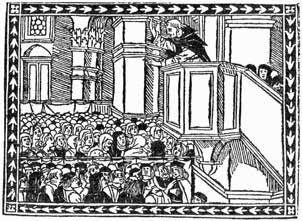
| Cassandra, the original humanities scholar, from a 15th century woodcut |
In
all seriousness, and if this is possible, the situation of the humanities scholar
may be more tenuous now than it was then. A few years after his speech, Emerson would
see the passage of the Morrill Land Grant act, which established Colleges
across the nation, including OSU, “to promote the
liberal and practical education of the industrial classes." In this era of
privatization and shrinking state support it’s hard to imagine the same thing
happening. In our practical society, with its emphasis on the bottom line, to
be a liberal arts major is almost an act of civil disobedience. Even President
Obama – who most Oklahomans, according to Senator Inhofe, believe is an Islamic
Communist – even President Obama has suggested that we should evaluate colleges
based on the earnings of their graduates.
We can make the case that humanities
graduates in fact do very well by these metrics. A recent study of 3 million US
residents showed that those who majored in liberal arts earned an average of
$2,000 more per year at their peak, compared to peers who majored in
professional or pre-professional fields. But the fact remains that this assessment of value would have made Emerson shudder, and it surely isn’t core to why we study the humanities. For Emerson, “the American scholar...is
one who raises himself from private considerations, and breathes and lives on
public and illustrious thoughts. He is the world's eye. He is the world's
heart. He is to resist the vulgar prosperity that retrogrades ever to
barbarism, by preserving and communicating heroic sentiments, noble
biographies, melodious verse, and the conclusions of history. Whatsoever
oracles the human heart, in all emergencies...has uttered as its commentary on
the world of actions, — these he shall receive and impart.”
Nice work if you can get it!“The Oracles of the human heart” is pretty high flying stuff, but at its base is a good definition of the humanities, and the reason they almost necessarily exist in a state of perpetual crisis. After all, we don’t always want to hear oracles, or the judgments of history. As early as Aeschylus, Cassandra was a kind of oracle – gifted with the power of prophecy, she was able to foretell the fall of Troy, to warn against that very suspicious gift of the big, wooden horse – but she also had the curse of not being believed. She is the original Lady of Perpetual Crisis, and perhaps the original humanities scholar. When the humanities are doing their job – when they are plumbing the depths of history and culture to speak unpopular truths – they frankly should be in crisis.
Nice work if you can get it!“The Oracles of the human heart” is pretty high flying stuff, but at its base is a good definition of the humanities, and the reason they almost necessarily exist in a state of perpetual crisis. After all, we don’t always want to hear oracles, or the judgments of history. As early as Aeschylus, Cassandra was a kind of oracle – gifted with the power of prophecy, she was able to foretell the fall of Troy, to warn against that very suspicious gift of the big, wooden horse – but she also had the curse of not being believed. She is the original Lady of Perpetual Crisis, and perhaps the original humanities scholar. When the humanities are doing their job – when they are plumbing the depths of history and culture to speak unpopular truths – they frankly should be in crisis.
The word comes from the Greek, krisis (κρίσις), turning point, or the Greek verb krino (κρίνω) "to separate, judge, or
decide.” The humanities look
at the panorama of history and critique those aspects of the world that outrage
our sense of human justice. They separate and analyze the best and worst of
what it means to be human.
So what did Emerson think the
American scholar should stand for – what truths should this scholar speak? “The
American idea,” he said, “is emancipation, to abolish kingcraft, feudalism,
black-letter monopoly, it pulls down the gallows, opens the doors of the sea to
all emigrants” (“The American Idea," Complete Works, 593). Sadly, those goals have
much the same relevance here in 2014 as they did at Harvard in 1837. For all
the triumphs of emancipation, "kingship," measured as inequality, is alive and
well. And the recent, botched execution in Oklahoma has sadly shown that in at least 32
states we haven’t pulled down the gallows – that in many areas we’ve merely put
the gallows behind a curtain.
But isn’t attacking “emancipation,
kingcraft, and the gallows,” while opening the door “to all emigrants” a tall
order for the humanities? Perhaps. And it is also true that humanities scholars
have been as complicit as anyone in their own disappearance from the public
eye. In some ways we’ve become too narrow, too specialized, and too reluctant
to engage with crisis. But it is also true that humanities scholars have helped
lead the great advances in social justice since Emerson gave his speech, from
Walt Whitman, giving voice to emancipation, to the student of Reinhold Niebuhr,
Martin Luther King. When I arrived at OSU in the fall of 1994, I
distinctly remember that the fledgling LGBT Club at OSU staged a day of
solidarity – a denim day, where you were supposed to wear denim to show your
support. When I left my calculus class that day the sidewalks were covered, in
response, with really hateful anti- gay graffiti – and I also remember one of
my study partners from calculus, as he surveyed the scene, saying that we
should take a baseball bat to anyone who dared to come out so publicly on our
campus. In that moment, I bit my tongue and withdrew from the duty of crisis.
But later that night I wrote, of all things, a poem, reflecting on the moment and my sense of
ethical failure, and then I wrote one of my first O’Colly articles, calling on students at OSU to rise above the hate. For a week after, when anyone called
my name as I walked across campus, my first instinct was to hit the ground. But
as it turned out, the vast majority of those voices were friendly.
I
don’t think I personally had much to do with this change, but I think it’s fair to say
that the kind of bigotry we encountered then is almost unimaginable on a campus
like OSU’s today. I live just up I-35, in a state where gay marriage has been
legal for seven years and where one our students, Zach Wahls, has gone from
high school quarterback, to Truman scholar, to Daily Show guest and bestselling
author of the book My Two Moms, just
in the past few years – and will, knock on wood, be a strong Rhodes candidate next
year.
Whether you agree with such changes or not, history will judge them. And while many
people, from many walks of life, were involved in making them happen, they were
led by the liberal arts and sciences -- by the writers,
filmmakers, philosophers, and cultural critics who began to show people like
me, a straight white kid from rural Oklahoma, the essential humanity of people
whose lives were superficially very unlike my own.
So
the next time someone asks if you think the humanities are in crisis, you can
answer, “I hope so!” Since it was founded in 1776, at a moment of crisis that
would begin to define the nation, Phi Beta Kappa has been fostering the debate
and ethical inquiry that has guided that process. But we are still not all we
can be. As John Milton says, in Areopagitica – his famous defense of free
speech, written during the crisis of the English Civil War – “The light which
we have gain'd, was giv'n
us, not to be ever staring on, but by it to discover onward things more remote
from our knowledge.” So welcome to the crisis – and my most sincere
congratulations!
Monday, April 14, 2014
Shakespeare and the Pile Drivers: Or Why Digital Humanities Should Be Open and Free
 I was on a panel on digital humanities at the Shakespeare Association of America (SAA) in St. Louis recently when the question of access, public input, and crowdsourcing arose. Academics, particularly at a Shakespeare association, can be a funny bunch, and deeply suspicious of the public. That's even true among the relatively small crowd doing work on digital humanities. One member of my panel argued, for example, that projects that encourage public crowdsourcing, for example to transcribe Civil War Diaries or to write biographies of early publishers, threaten to "reproduce the
 dominant discourse." I'm summarizing, but the argument was basically this: public contributors skew toward interest in white, male figures, obscuring minorities and women, and this is the fatal flaw in crowdsourcing. The final statement, I think verbatim was, "that may not be a problem for you, but it is for me."
Actually though, I don't see why the "public" discourse is any more a dominating one than the controlled scholarly discourse that flourishes within places like the SAA. Personally, I always get nervous when I hear someone saying that the masses are not really fit to write their own history and that the task is better left in the hands of a scholarly elite.
While we were at SAA in St. Louis, the Shakespeareans shared the hotel with a cosmetics association, and in the same month, the Pile Drivers of South Carolina also held their annual meeting in the same space. Frankly, I bet neither of those gatherings policed hierarchies as rigidly as the SAA. From tuition fees to registration, organizations like this are not necessarily on the side of the angels. More power to DH projects that change that dynamic.
Thursday, January 23, 2014
Marvell, Censorship, and the Coffe Shop Crowd
.JPG) |
| With permission of University of Iowa Special Collections |
The Rehearsal Transpros'd (1672) was an attack on Samuel Parker, the Bishop of Oxford -- but more than that, it was a defense of religious freedom and an argument for the the separation of church and state. But Marvell's biting, ironic style is what made it such a sensation and a scandal (you'll notice that Marvell's name doesn't appear on the title page -- he stayed anonymous to stay out of jail). In fact, not only does the Rehearsal, as a product of London's underground press, not include Marvell's name, but it doesn't include the name of a printer or publisher either. More than this, the first edition include a false imprint on the title page, which was all part of Marvell's joke, poking fun at a Samuel Parker for a geographical error made in his own work: "London, Printed for J.D., for the Assigns of John Calvin, at the Signs of the King's Indulgence, on the South Side of Lake Lemane" (the joke is that Parker mistakenly refers to Geneva being on the "rank soil of the south side of Lake Lemane" in his own book, while as Marvell points out, "the lake likes East and West, and Geneva is built on the West side of it").
It doesn't seem like much, but it was just such smart-assed humor that drove the authorities wild, and the censors quickly shut down printing of the book. Luckily for Marvell, King Charles II himself enjoyed the book, and so insisted it be allowed -- but the second issue was printed only with substantial revisions, including the title page pictured above, which removes Marvell's cutting humor.
This is where the Iowa copy gets interesting: here's an enlarged photo:
.JPG)
Although the censors had stepped in, Marvell's work was already the talk of the coffee shops, where the clever, sarcastic title page was clearly part of the appeal. The wag that bought this copy clearly also had access to the first edition, and copied in the original joke. He also went through the copy dutifully restoring other deletions that the censor, Roger L'Estrange, had demanded. But still more interestingly, while the annotator seems to know all about that first edition, he doesn't ever include the author's name -- was Marvell's identity, at this point, still a secret?
At any rate, the secret was out by the following year, when Marvell issued the Rehearsal Transpros'd: The Second Part, with his name on the title page. But Marvell continued to develop his ironic use of the paratext. Here's the title page from the University of Iowa copy of that book:
.JPG)
Notice that he's included a note saying that this edition had been "licensed" by the censors. And above that license, he's included another quote from his opponent: "If you have any thing to object against it, do your worst. You know the Press is open." This was Parker, challenging his opponents -- and by turning Parker's own words against him, once again, Marvell both takes up that challenge and implies that the press is not quite as open, or free, as the Bishops would have us believe.
Friday, November 1, 2013
On the Common Core, Naughty Books, and Ambiguity
A piece I've written over at The New Republic is getting lots of attention, so I thought I'd just expand on a few things here. I think the ambitions behind the Common Core are good ones, but I agree with Dianne Ravitch and co. that the whole thing was rushed and probably needed more input from those on the ground. Most troubling, I think, is the general tendency in education "reform" right now to reduce everything to some quantifiable metric, including literary complexity. It is a frightening assumption, in so much of our society right now, that if an experience can't be reduced to data it really isn't worthwhile. When we bring this assumption to bear on books or art it compromises the "human" experience at the center of the humanities. In short: it makes our teachers, and our children, less human.
Yes, I understand that some of the metrics used to measure reading complexity are primarily intended to improve comprehension -- and I agree this is a worthy goal for at least one part of our literacy education. I also understand that the standards carefully explain that students should also learn more nuanced reading skills. But the emphasis and the energy behind the Common Core points more in the direction of "comprehension" and quantifiable data than it does in the direction more broadly defined "reading." The CCSSO documentation repeatedly makes it clear that the final goal is better algorithms and metrics, better testing regimes, more failproof systems.
We must recognize that such systems, in both their conceptualization and implementation, often disempower and devalue teachers. The best teaching systems in the world -- like Finland's -- treat teachers as experts in their field and demand their expertise. They then trust teachers to match reading materials to children in a holistic fashion. This is the way it used to be, in some places, in America too. At least that was my lucky experience, growing up in a small, rural school, in a poor community in far western Oklahoma. I was a loudmouth, smartass kid, who was always in trouble for disrupting class. In my 7th grade year, I literally spent every day of the first month in after school detention. But in my 8th-grade year, I got lucky. That's when my English teacher took me aside and said: "you know what, you seem to get this literature we're reading pretty well. Why don't you go over to my bookshelf -- the one over there behind my desk -- and find something else you might like?" She particularly suggested I might want to take a look at The Catcher in the Rye, or maybe Clockwork Orange.
Clockwork Orange? What Jr. High kid today gets to read that book in school? But that teacher let me read all the naughty books -- the books that I, at least, felt like were just a little bit forbidden -- and I loved it. That semester I not only read Clockwork Orange and Catcher in the Rye, but also most of Steinbeck, On the Road, and everything I could find by Kurt Vonnegut. These books gave voice to some of the social discontent I'd begun to feel but never been able to articulate. They resonated with me, and in some very real sense they saved me, or at least saved my teachers from some of my disrupted disaffection.
I never stopped reading, although I did eventually get into Shakespeare and Milton too. I became an English professor so I could teach them all the time. And I hope that some of my students become teachers in a system where they're treated like professionals who can figure out what students would like to read -- what they need to read -- without using some stupid algorithm.
Yes, I understand that some of the metrics used to measure reading complexity are primarily intended to improve comprehension -- and I agree this is a worthy goal for at least one part of our literacy education. I also understand that the standards carefully explain that students should also learn more nuanced reading skills. But the emphasis and the energy behind the Common Core points more in the direction of "comprehension" and quantifiable data than it does in the direction more broadly defined "reading." The CCSSO documentation repeatedly makes it clear that the final goal is better algorithms and metrics, better testing regimes, more failproof systems.
We must recognize that such systems, in both their conceptualization and implementation, often disempower and devalue teachers. The best teaching systems in the world -- like Finland's -- treat teachers as experts in their field and demand their expertise. They then trust teachers to match reading materials to children in a holistic fashion. This is the way it used to be, in some places, in America too. At least that was my lucky experience, growing up in a small, rural school, in a poor community in far western Oklahoma. I was a loudmouth, smartass kid, who was always in trouble for disrupting class. In my 7th grade year, I literally spent every day of the first month in after school detention. But in my 8th-grade year, I got lucky. That's when my English teacher took me aside and said: "you know what, you seem to get this literature we're reading pretty well. Why don't you go over to my bookshelf -- the one over there behind my desk -- and find something else you might like?" She particularly suggested I might want to take a look at The Catcher in the Rye, or maybe Clockwork Orange.
Clockwork Orange? What Jr. High kid today gets to read that book in school? But that teacher let me read all the naughty books -- the books that I, at least, felt like were just a little bit forbidden -- and I loved it. That semester I not only read Clockwork Orange and Catcher in the Rye, but also most of Steinbeck, On the Road, and everything I could find by Kurt Vonnegut. These books gave voice to some of the social discontent I'd begun to feel but never been able to articulate. They resonated with me, and in some very real sense they saved me, or at least saved my teachers from some of my disrupted disaffection.
I never stopped reading, although I did eventually get into Shakespeare and Milton too. I became an English professor so I could teach them all the time. And I hope that some of my students become teachers in a system where they're treated like professionals who can figure out what students would like to read -- what they need to read -- without using some stupid algorithm.
Wednesday, October 9, 2013
How to COPY a Book Proposal
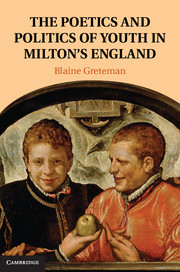 Over at the Chronicle of Higher Education, Rachel Toor explains "How to Write a Good Book Proposal," and she offers some excellent advice, especially for nonfiction writers and novelists. I'd like to chip in here, though, with something for writers of academic books -- and for writers who'd rather copy a form than construct one from a set of instructions. I probably fall into that later category: give me a formal model (newspaper article, book review, personal essay) and I can usually adapt to it pretty easily, although my eyes glaze over within a paragraph of any guide about "how to" write this or that. It may be a weakness, but it's my weakness.
 So, for those of you who share that weakness, I'm posting the book proposal that I sent to Cambridge University Press and that led to my recently published book. Is it a perfect model? I doubt it. But I did copy it from some pretty good models! One caveat: my final book changed quite a bit from this, both in terms of content and organization. But this was good enough to get me in the door.
Childish Things: The Poetics and Politics of Youth
in Milton’s England
Book
Proposal
Blaine
Greteman
Childish
Things argues that coming of age
in seventeenth-century England was a uniquely poetic and political act. Early modern authors used childhood and
maturity to address contentious questions of political representation – about
who has a voice and who can speak on his or her own behalf. Writers since Aristotle had described
children as creatures of pure mimesis.
Naturally embodying the poetic impulse, children imitated the voices of
others as they cultivated more authoritative speech and ultimately left
childish babble behind. Early-modern educators, playwrights, and poets
repeatedly staged this drama, and if we accept Jacques Rancière’s suggestion that the central problem
of all politics is knowing “whether the subjects who count in the
interlocution...are speaking or just making a noise” it could not fail to be
political.
In seventeenth-century England,
after all, consent was explicitly figured as voice. Electors “gave their voices,” shouting assent
to select their parliamentary representatives, while those whose age or
behavior made them incapable of consent were deemed legal infants, from the
Latin infans, “voiceless.” Historians
like Mark Kishlansky and Derek Hisrt have shown that government by consent
became the new paradigm during this dynamic period, and I argue that the
threshold between infancy and adulthood accordingly became the focus of special
scrutiny and enormous creative energy. Childish
Things focuses on printed and manuscript works by Ben Jonson, John Milton,
Thomas Hobbes, and their contemporaries that ask how voice emerges from infancy
and how childish speech before that moment complicates ideas of human agency
and obligation. In each case, the
ability of poets and dramatists to produce and reproduce powerful voices
provides an important part of the answer. According to many humanist pedagogues
and the men who learned the dramatic arts in their schools, poetry was a
discipline that could “embowlden our youth and try their voices,” as one
educator put it. This disciplinary
function encouraged antitheatrical critics like William Prynne to rail against
the similarities between infantilizing dramatic representation and a political
system where children could become members of Parliament. But more radical reformers seized on the
child’s unruly nature and mimetic responsiveness as a radical resource, a voice
of innocence and channel for the divine.
Childish
Things suggests that we must understand the distinction between youth and
age as a power relation constructed in historically specific discourses and
social contexts. Over the last forty years, historians have carefully revised
Philippe Aries’ claim in Centuries of
Childhood (1962) that childhood did not exist as a distinct phase of life
before the later seventeenth century, while retaining his sense that concepts
of childhood are culturally determined. I draw on this work as I focus on the
tendency of seventeenth-century writers to define children in terms of their
mimetic capacities and poetic responsiveness, but I shift the center of gravity
to explore the seventeenth-century idea that childhood could persist long after
sexual maturation. The cases I examine
lie at the outer limits of childishness and extreme precocity, where voters
elected twelve-year-olds as Members of Parliament before they could legally
vote and theatre impresarios advertised child actors who were actually twenty,
thirty, or forty years old. Historians
like Paul Griffiths and Ilana Krausman Ben-Amos describe many of these figures
as “youths.” But Childish Things demonstrates the many ways they continued to be
conceptualized as children and focuses on the moments when they became
subjects, speaking their own adult status into being. Poetic and political representation meet in
the figure of the child on the cusp of adulthood – the grown boy still playing
the woman’s part on stage, the young girl performing as The Lady in Milton’s Maske, the newly-created Adam and Eve
making their way through the wider world at the conclusion of Paradise Lost.
As those examples make clear, the
poet, pedagogue, and polemicist John Milton is a pivotal figure in this study.
“Shall we never grow old enough,” he asked in one of his final political
tracts, “to be wise?” It is a typical
expression of Milton’s perpetual anxieties about his own maturity and that of
the British people, and this book draws broadly from his poetry and prose to
parallel Milton’s own development from budding poet to national tutor with the
troubled birth and growth of consent in the English polity. At the same time, I
show how such development looks back to and arises out of models of childhood
staged by Jonson, Shakespeare, the humanists, and the antitheatrical critics
who attacked them. For these writers, to speak as a child may simply mean to
speak nonsense or to parrot others, but it may also enable one to channel
something more powerful than oneself.
Status of the Manuscript
The completed manuscript is
approximately 90,000 words, including endnotes, and is ready to be reviewed by
the press upon request. A version of the first chapter, “Coming of Age on
Stage” is forthcoming in English Literary
History (ELH) and a version of
the third chapter “‘Perplex’t Paths: Youth and Authority in Milton’s Work,” was
published in the Summer 2009 issue of Renaissance
Quarterly. I do not plan to publish
additional chapters. As a tenure-track
professor at the University of Iowa I have ample time to devote to revisions,
and as a former writer for TIME magazine
I am experienced and efficient at working through the editorial process.
Readership
Childish
Things will appeal broadly to students and scholars of early modern English
literature, drama, and history. In a recent volume of Renaissance Quarterly the historian
Margaret King assessed the existing histories of childhood and noted the need
for work that would address “the
demarcations made on the spectrum from conception to maturity.” Problem
Children helps fill that void. The
book’s argumentative spine, tracking the development and definition of consent,
will also engage intellectual historians and scholars of the Civil War and
legal historians, while its theoretical engagement with Hobbes, Hanna F. Pitkin,
Philip Pettit, and John Rawls, will be of interest to students of political
philosophy. Shakespeareans and students
of the theatre will attend to the new research on child actors, which
significantly alters our understanding of the seventeenth-century stage. Finally, with three chapters on John Milton’s poetry and prose, I expect the
book to find a particular audience among Milton scholars and be reviewed in
journals like Milton Studies and Milton Quarterly.
Related Works
Michael Witmore’s Pretty Creatures (2007) and Edel Lamb’s Performing Childhood (2008) have
recently developed the ground Leah Marcus broke with Childhood and Cultural Despair (1978). These books focus on the
literary representation and aesthetics of very young children and neonates,
establishing the child as central to early-modern poetics. None, however, explores the strange territory
at the outer bounds of childhood, and perhaps for that reason no other literary
study develops the relationship between the poetics of childhood and the
question of consent. Likewise, promising works like Su Fang Ng’s Literature and the Politics of Family (2007)
have focused on patriarchal and anti-patriarchal metaphors with an eye to
gender and hierarchy, but without attending to children and their conceptual
link to issues of mimesis and voice. Likewise, individual authors in my study,
especially Milton, have been richly contextualized in terms of their
revolutionary moment in works like David Norbrook’s Writing the English Republic (1999) and David Loewenstein’s Representing Revolution in Milton and His
Contemporaries (2007). But it is
safe to say that none of these works have considered the politics of childhood. Although Holly Brewer’s legal history, By Birth or Consent (2008), focuses
largely on the American context and does not include literary analysis, it
shows that such a consideration is due. Childish Things unites discussions of
the poetics and politics of youth. It
does not simply use poetry and drama to illuminate social movements or testify
to a broader discursive moment, but argues that children in form a nexus
between poetry and politics, a singular locus for poetry’s disciplinary and
transformative power.
Contents
Introduction
“Childhood,” wrote Henry Cuffe in a
hugely popular text of 1607, “is the first part and age of a man’s life,
wherein their generation and growth is perfected, and this lasteth (for the
most part) untill wee be five and twenty.”
Cuffe draws on the best authorities, but his parenthesis reflects a
fundamental ambiguity about the boundaries of childhood shared across the
legal, religious, and educational writings examined in this introduction. Although they often bore full adult
responsibilities, no amount of good behavior, maturity, or intelligence could
guarantee adult status to children in their teens, twenties, and even
thirties. One trespass, however, could
do the job instantly. The legal principle of “malitia supplet aetatem,” or malice supplies the age, removed the
uncertainty, allowing even the youngest children to be executed as adults if
they, like Adam and Eve, possessed the knowledge of good and evil. My introduction traces the overlapping
political, religious, and poetic concerns that make malitia supplet aetatem a fundamental pattern in early modern
culture from Erasmus to Locke. As
individuals enter adult society, they reenact man’s fall with each generation,
compromising their newfound voices. The
book’s recurring dilemma is the struggle to escape that double bind, to seize
the ability to speak without seizing the inheritance of sin.
Chapter 1: Coming of Age on Stage:
Jonson’s Epicoene and the Politics of
Childhood in Early Stuart England
The same qualities that made the
child incapable of rational consent made him the ultimate exemplar of poetic
response, and Chapter 1 explores the implications of this dynamic in Epicoene, a play that held its
popularity both before the revolution and after the restoration. Discussions
of children’s theatre companies have reached a consensus view that the plays’
aesthetic power derived in some part from the boy actors’ diminutive size – an
estrangement effect noted by Michael Witmore, Peter Stallybrass, Michael
Shapiro, and others. But my research
shows that by the time James I took the throne, the actors in London’s
children’s theatre companies were often fully grown men performing as children,
and in Jonson’s play we can see how
their liminality facilitated Stuart theatre’s exploration of the Jacobean
subject’s vexed political status.
As grown men performed childhood on
stage, they testified to theatre’s disciplinary power even as they enacted a
fictional freedom not available outside the theater walls. The young man
dressed as the titular “silent woman” of Jonson’s play emblematizes this
predicament perfectly: he speaks loudly and constantly as long as he performs
his female role, lapsing into true silence only when he is finally revealed as
a mature but infantilized man and the play ends. At a time when James countered parliamentary
unrest by adopting and expanding the rhetoric of the firm but benevolent
father-king, works like Jonson’s asked whether it was possible, or even
desirable, to leave childish things behind.
Chapter 2: Minors
No Senators: Children, Literature and the Problem of Consent
In the sixteenth and seventeenth
centuries it was surprisingly common for children under the age of majority to
serve in Parliament, where they illuminated in stark relief the same crisis of
agency dramatized in plays like Epicoene. In this rarefied space, an infant could
legislate for the nation, although outside of Parliament he had no legal
authority to speak for himself, an irony the MP for Lichfield, Richard Weston
highlighted when he complained “it is not fit, that they should make Laws for
the Kingdom, who are not liable to the law.”
This chapter shows that for many, like the self-described “scourge” of
stage plays William Prynne, such facts revealed disturbing similarities between
dramatic and political representation in a country poised between tyranny and
liberty. In Minors No Senators, a tract published both early in the Civil War
and at the Restoration, Prynne attacked child MPs with strikingly
anti-theatrical language that
illuminates the broader debate over education, poetry, and politics. Theoretically, the child’s ability to channel
the voices of others might offer a vehicle for the people’s will, but the
practical effect of using Parliament as a finishing school for elites also
indicated the disciplinary and symbolic purpose of England’s chief
representative body. Accordingly, as the principal of
representation became central to discussions of English governance, the
presence of children on the public stages of Parliament and playhouse forced a
fundamental question: did the type of
representation embodied by the mimetic child demonstrate a failure of agency
and consent, or did it indicate of a kind of representation that could operate
successfully in the absence of consent? This is not just a political question
that can be illuminated by literature, with poets and playwrights shedding
light on their culture’s attempts to conceptualize the basis of
obligation. Instead, it is a fundamental
crux that troubles contemporary claims for poesy’s shaping power and forms a
recurring theme in the works of John Milton and his contemporaries in the
following chapters.
Chapter 3: ‘Perplex’t Paths’: Youth and Authority
in Milton’s Early Work
Not all reformers attempted to sever
the link between poetic and political representation. The kind of authoritative consent Prynne
envisioned was problematic, in part, because the period’s broad
conceptualization of childhood made it difficult to explain when youths became
properly adult. Prynne dodged the
question by declaring that legislators should be “Old Men” of at least fifty.
But Milton was never one to step lightly away from a limen, and in early works like Comus
he takes up the question of how children on the cusp of adulthood become
free individuals with the authority to shape their own destinies. In works that
prefigure his educational tracts and play a performative role in his own
maturation, Milton suggests that only a daring engagement of the child’s
passionate and sensuous nature allows a powerful, adult voice to emerge.
This is a peculiarly poetic process,
immersing the child in a world of delights that she echoes, resists, and
transforms; as the voice becomes
authoritative, the human will comes into its own. This proleptic moment, in which voice
outstrips the will, generates the central anxiety in Milton’s early works. The
youth who speaks before gaining the right to judge his own words may echo the
wrong things, recognizing the malice of his will only after innocence cannot be
recalled. As I demonstrate this dynamic in early
works like Ad Patrem, Sonnet 7, and Comus, I also address a lacuna in Milton
studies. Recent revisionary biographical work by Gordon Campbell and Thomas
Corns has suggested that Milton began his career as a conservative with
high-church leanings, embracing “Laudian Arminianism and Laudian style” before
gradually becoming radicalized. But
until Childish Things we have had no
clear discussion of the role Milton’s poetry itself played in this
developmental process, as a young author found his voice through a process that
generated his later radicalism.
Chapter 4: ‘Children of Reviving Libertie’: The
Radical Politics of the Well-Disciplined Child
Milton’s career usefully complicates
the dominant account of Renaissance humanist education as a disciplinary,
conformist force popularized by scholars like Lisa Jardine, Anthony Grafton,
and Richard Halpern. This chapter begins
by exploring the ways that Milton, Comenius, and other mid-century reformers
adapted humanist pedagogical theories and concepts of childhood to revolutionary
use. Both Comenius and Milton develop
the humanistic goal of willing submission into a radical discipline, but while
Comenius attempts to purge his program of the poetic error that had long
troubled humanist pedagogues, Milton insists that these dark materials are the
very stuff of virtue. Milton’s singular
departure from the pedagogical tradition drives not only Of Education, but also polemical works including Eikonoklastes, Areopagitica, The Readie and
Easie Way, and his epic First and
Second Defense of the English People.
In such works, he draws on metaphors
of childhood and wardship as he encourages his countrymen to prove that their
liberty is not, as he puts it in the Tenure
of Kings and Magistrates, merely “a ridiculous and painted freedom, fit to
coz’n babies.” Milton describes a people who lack a voice but who possess a
radical capacity for growth and change, and a more complete understanding of
his pedagogical model forces a reassessment of his infamous elitism. Milton certainly believes that the nation in
wardship needs “a potent tutor, an overseer, a faithful and courageous
superintendent of your affairs.” But
whether he sets himself or Cromwell up in this guardian position, he clearly
intends it to be temporary, and I conclude by arguing that his prose works both
describe and constitute a poetic education that can make the people “fittest to
chuse” for themselves. The phrase is taken from The Readie and Easie Way, written on the eve of Restoration when
Milton’s estimation of the people’s actual readiness is at its nadir. Even
here, however, Milton continues to suggest that his own words may raise them up
as “children of reviving libertie.”
Chapter 5: ‘Something of Gratitude’: Hobbes’
Prodigal Fictions
While Milton employs concepts of
childhood and development to construct a model of political change, Hobbes uses
the child’s vacated agency as the model subjectivity for a system of political
stasis. Almost no critical attention has
been paid to the role of children in Hobbes’s system, although in Leviathan and elsewhere the philosopher
makes it clear that “the Child’s consent” to receive nourishment from its
mother precedes all other social agreements.
How and when does the child demonstrate this consent? Such questions go to the heart of mid-century
debates over obligation and whether social relations derive from consent and
contract or altruism and patronage.
Critical neglect of Hobbes’ children
started early. In De Cive, Hobbes suggests that to understand how contract operates
in the state of nature we should “consider men as though they were suddenly
sprung from the earth (like mushrooms) as adults right now.” Beginning from
such a position, Hobbes can explain with almost mathematical precision how
obligation arises from conquest and contract as men make rational choices to
preserve themselves. But children lack a
fully developed rational faculty, and both Royalist and Republican critics
attacked Hobbes for eliding them from his account. Surely their obligation to parents demonstrated
the principal role of love, nurture, and lineage in the state? I argue that
Hobbes developed his answer over the course of his career, fundamentally
altering his definitions of “reason” and “choice” as he reconfigures parental
nurture and filial gratitude as a contractual exchange. Mimetic and irrational, the child who can
become obligated through no rational decision or act becomes a perfect figure
for theorizing the obligation of the masses of men who never exercise a real
voice in the political system to which they owe allegiance.
Chapter 6: ‘Unexperienc’t Thought’: Filial Affect
and Education in England
Through Satan, Milton depicts the
failure of the Hobbesian psychology of contract and of the static worldview it
requires; Satan attempts to elide filial ties by proposing that the angels may
be “self-begot,” and when he finally does acknowledge the Father’s gifts he can
only experience gratitude as debt, love as a system of exchange. I argue that Adam and Eve demonstrate
Milton’s alternative, their experience of obligation drawn from humanistic
conceptions of childhood and the poet’s own radical pedagogy. This final chapter not only offers a new way
of reading Paradise Lost in the
context of the many contemporary works depicting Adam and Eve as children, but
also refigures our notion of the poem’s notorious disciplinary and hierarchical
tendencies.
Paradise
Lost has earned a reputation for bullying, from Stanley Fish’s depiction of
the poem as a hectoring schoolmaster to Mary Nyquist’s influential argument
that it enacts a form of female subjectivity that will be endlessly reiterated
in future novels where heroines learn “the value of submitting desire to the
paternal law” (123). But Milton leverages notions of childhood and familial nurture
to elucidate forms of obligation without subjection, suggesting that a society
of truly paradisal freedom might be constructed on the filial principal of
fealty to God’s image written on the heart.
The difference from Nyquist’s model is subtle but essential, as Milton
himself recognized as early as The Reason
of Church Government, where he argued that God is no “schoolmaster of
perishable rites, but a most indulgent father governing his Church as a family
of sons in their discreet age.” Paradise
Lost depicts and enacts such governance, an education via echoes and
mirrors that serves as a revolutionary resource and a path to adult voice. As Adam and Eve wander out of Eden with the
world all before them Milton suggests that, for God’s children, this education
is never complete.
Tuesday, August 20, 2013
School's in, Book's Out!
My own kids head off to their first day of school tomorrow...and my book about children and the history of using literature to educate them just came out today. How's that for a segue? And how's this for a marketing pitch, oh loyal reader (for I suspect you are fit, though very few)? Cambridge University Press has given me a link to a 20% discount code for the book, which you can find here. That's right -- using that link, the book will only run you a cool $76! It's not cheap, but if you buy a copy, and bring it to me, I will sign it with my standard-issue Renaissance-scholar feather quill. Thursday, August 15, 2013
Cloudy With a Chance of Pain...
 |
| Illustration from our article in THE, August 15, 2013 |
I have a new article on MOOCs in today's Times Higher Education.
This was a new kind of publication for me -- I co-wrote it with my old friend from Oxford, David Roberts, who now works in international development for the U.S. Government. It started off as a brainstorming session about where MOOCs could take the university, then evolved into a Swiftian satire of higher ed, and then finally took its printed form as an opinion piece. As it makes it clear, MOOCs still have a lot to learn -- but we also think they could add a nice shot of innovation to a system that could use it.
The process of writing it, on the other hand, was another confirmation of an idea my network research has been emphasizing a lot: that authorship is nearly always complex, multiple, and in some ways bureaucratic, rather than singular and romantic!
Subscribe to:
Posts (Atom)